
SUMMER BOOK CLUB

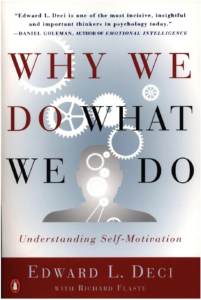
Why We Do What We Do: Understanding Self-Motivation by Deci & Flaste
Thursdays, 6:30-7:30PM CDT, June 25, July 9 & August 6.

This is a free, online, 3-session series. Join any or all of the sessions! We will share a summary at the beginning of our time together followed by discussion topics that everyone can participate in, whether you have completed the reading or not.

Session 1 (June 25): Introduction & Part 1, The Importance of Autonomy & Competence (pp. 1-73).

Session 2 (July 9): Part 2, The Role of Interpersonal Connectedness (pp. 77-137).

Session 3 (August 6): Part 3, How it All Works & the Conclusion (pp. 141-211).

About the book

This book explores the scientific foundations of human agency. We will discuss Self-Determination Theory (autonomy, competence & relatedness) and how to shift from the superficial pressure of external expectations toward more self-authored and sustainable performance. Intrinsic motivation is essential for students, employees, leaders and societies to learn, adapt and thrive over time. Let’s discuss how we can cultivate conditions so that motivation emerges naturally.

About your hosts

Jacqueline Fiore is an Industrial-Organizational Psychology practitioner and founder of Elite Growth Partners with over two decades of leadership experience ranging from corporate initiatives to service as a decorated U.S. Army Sergeant and OIF Combat Veteran. She specializes in creating empowering work environments where individuals thrive – a focus that aligns deeply with the principles of autonomy and motivation within Self-Determination Theory. Jacqueline leverages her expertise in organizational effectiveness and strategic planning to help leaders drive sustainable growth and collective success.

Dr. Katherine Sanders is a Work Systems & Human Factors Engineer focused on designing healthier, more effective workplaces. She designs and teaches leadership and organizational development programs to help leaders align work design with sustainable employee health, engagement and innovation. Her work integrates research from organizational behavior, occupational health and systems engineering to address the root causes of common “people problems” such as burnout, toxic cultures, turnover, accidents and errors. Katherine brings a practical, systems-based lens to complex organizational challenges and sees autonomy and Self-Determination Theory as foundational for workplace and public health.

SPEAKING

Burnout, turnover, errors, disengagement, and “toxic” cultures are rarely just people problems—they are often symptoms of system issues. I help leaders identify leverage points within their organizations to create healthier, higher-performing work systems.

Formats are customized to your group’s needs and can include:

  • virtual one-hour seminars (live or recorded)
  • virtual seminar series and/or one-day workshops (live or recorded)
  • conference plenary talks (virtual or on-site)
  • on-site seminars
  • on-site workshops
  • on-site retreats

Fees range from $1000 to $10,000 (plus travel expenses).

Coaching (for individuals or groups) can be added to help your organization move from conversation to implementation. My hourly rate is $450. Coaching packages range from 3 to 12 months, for individuals or groups.

TOPICS

THE SYSTEM BENEATH THE SYMPTOMS

Burnout and related trends like quiet quitting (and its cousins, quiet firing, quiet hiring, quiet promoting, quick quitting, resenteeism, etc.) have been getting a lot of attention since the great resignation.  I see these trends as symptoms of deeper issues.  We’ll discuss what these trends are and what they’re saying about how we work.  We will use systems thinking models to assess the causes, how they arise in your context and how you might intervene to shift them.

SURGEON GENERAL’S MODEL FOR WORKPLACE MENTAL HEALTH & WELL-BEING

The Surgeon General’s Office has shared a model for workplace mental health and well-being.  The office has also issued a complementary report on the health effects of loneliness (aka, the healing effects of social connection).  I can introduce your group to the concepts and help you discern how it applies to your organization.

WHY WELLNESS INITIATIVES (BY THEMSELVES) CANNOT HEAL A SYSTEM

Employee exhaustion, loneliness and burnout continue to climb while engagement levels continue to decrease. Wellness initiatives have been called upon to help reverse those trends.  From what we know about how work impacts human health, wellness programs can help some individuals, but they cannot heal a sick system.  We will use some frameworks to help your group think about what’s going on in your workplace and how you might choose to intervene.  This might include investing in wellness programs along with structural interventions that have the potential to improve your work system’s health.

WHY EMPLOYEE BENEFITS CAN’T INCREASE ENGAGEMENT

Employee benefits have been used for decades to improve employee engagement.  Unfortunately, they haven’t (and can’t).  Benefits are important to employees, but they do not impact employees’ intrinsic motivation.  The good news is that we know what can help employees engage – making sure people’s jobs are designed so that they have a job worth engaging.  We will discuss the design of work to promote motivation, health and engagement.  We’ll also clarify where benefits fit into that conversation, so your organization knows where to invest its resources.

THE FUTURE OF WORK: DESIGNING WORK FOR HUMANS

As we incorporate more technology into the workplace, it’s increasingly important that we intentionally create roles for humans to be healthy and sustainably productive.  Technological advancements have the potential to improve human health, but used indiscriminately, they can also erode it quickly.  We will discuss what humans offer and need in order to make their best contributions at work as well as how technology fits into a health-promoting scenario.

RECENT EVENTS

Health Professions Educators Conference, Plenary, August 9, 2023: How Healthcare Educators can help Prevent and Heal Exhaustion and Burnout (for themselves and their students)

Magna Publications Virtual Seminar, August 17, 2023: Applying the Surgeon General’s Model for Workplace Mental Health and Well-Being to Higher Education

Montana Nonprofit Association Annual Conference, Pre-Conference Workshop September 19 & Online Seminar, September 26, 2023: Translating the Surgeon General’s Model for Workplace Mental Health and Well-Being to Nonprofits

Leadership in Higher Education Conference, Pre-Conference Workshop, October 12, 2023: Hiring Committees that support Campus Strategic Direction

Leadership in Higher Education Conference, Invited Session, October 12, 2023: Using Systems Thinking to Increase Campus Innovation

RELATED ARTICLES

Campus Change Readiness, Part 1: Trust, Skills & Capacity by Katherine Sanders & Patrick Farrell, in Academic Leader, July 10, 2023.

Campus Change Readiness, Part 2: Theory to Practice by Patrick Farrell & Katherine Sanders, in Academic Leader, August 7, 2023.

The System Beneath the Symptoms, Part 1: Levels of Intervention by Katherine Sanders, in Academic Leader, September 5, 2023.

The System Beneath the Symptoms, Part 2: Root Causes by Katherine Sanders, in Academic Leader, October 2, 2023